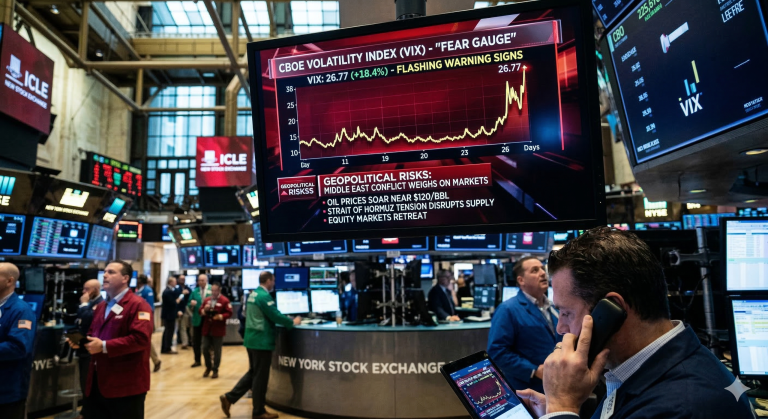
Middle East conflict has disrupted one of the world’s most critical oil shipping lanes, sending crude prices to their biggest weekly gains in years — and Goldman Sachs analysts say two Chinese petroleum giants stand to be among the biggest beneficiaries.
A Historic Week for Oil Prices
The escalating conflict involving Iran has effectively halted commercial shipping through the Strait of Hormuz over the past week, triggering one of the most dramatic oil price moves in recent memory. The strait is among the most consequential chokepoints in global energy — roughly 20% of all petroleum liquids traded worldwide flow through it, with the majority destined for Asian importing nations.
The supply disruption and the uncertainty surrounding its duration sent markets into a sharp repricing. Brent crude surged 28% last week, its largest weekly gain since April 2020. U.S. crude futures recorded their biggest weekly gain in the entire history of the contract, dating back to 1983.
+28%Brent crude — weekly gain
20%Global petroleum via Hormuz
$100Goldman’s Brent scenario target
Brent settled Friday at $92.69 a barrel. According to Goldman Sachs Asia Pacific energy analysts, in a scenario where flows through the Strait of Hormuz drop by 50% for one month and remain 10% below normal for an additional 11 months, Brent could rise to $100 a barrel. The bank’s baseline assumption as of March 2 priced in an average Brent level of $70 per barrel for the full year.
Goldman’s Top Picks: CNOOC and PetroChina
Even at oil prices well below the crisis scenario — in a range of $80 to $90 per barrel — Goldman’s analysts see meaningful upside for two Hong Kong-listed Chinese energy majors. Both China National Offshore Oil Corporation (CNOOC) and PetroChina could see their full-year free cash flow boosted by more than 10% under that pricing environment, according to the bank’s March 2 report. Goldman rates both stocks a buy.
🛢️ Goldman Sachs Asia Pacific — Key Energy Calls
CNOOC — Rated Buy | FCF boost: >10% at $80–$90 Brent
PetroChina — Rated Buy | FCF boost: >10% at $80–$90 Brent
Sinopec — Less favored | Domestic pricing ceiling limits upside
Goldman baseline assumption: Brent avg. $70/bbl (as of March 2)
Both CNOOC and PetroChina shares hit 52-week highs on March 3 before giving back some gains into the end of the week. The two companies represent distinct but complementary exposures within China’s energy complex. CNOOC has its roots in offshore oil exploration and production, built through partnerships with international oil firms. PetroChina operates a broader domestic business that also encompasses refining and distribution networks across the country. Together, they are two of China’s three state-owned oil giants.
Chinese State-Owned Oil Giants — Goldman Sachs Snapshot
| Company | Focus | GS Rating | US Investor Access |
|---|---|---|---|
| CNOOC | Offshore E&P, international JVs | Buy | ⚠️ Restricted since 2021 (Treasury Dept.) |
| PetroChina | Domestic E&P, refining, distribution | Buy | ✅ No purchase restrictions |
| Sinopec | Refining, chemicals (world’s largest refiner) | Less Favored | ✅ No purchase restrictions |
Why Sinopec Doesn’t Make the Cut
Not all of China’s oil majors are positioned equally to benefit from higher crude prices. Goldman’s analysts expressed a less favorable view on Sinopec, the world’s largest oil refiner and, as of last year, the world’s largest chemicals producer. Sinopec shares also reached a 52-week high on March 3, but the bank’s analysts see a structural headwind that limits its upside.
“For Chinese refiners like Sinopec, given the domestic product ceiling calculation mechanism does not factor in increases in international freight rates or official selling prices, we see the net impact as skewed to the negative side.”
— Goldman Sachs Asia Pacific Energy Analysts, March 2 Report
In simpler terms: Sinopec buys crude at rising global prices but sells refined products domestically at prices capped by a government-controlled mechanism that doesn’t fully account for elevated international shipping or supply costs. When crude soars, refiners like Sinopec can find themselves squeezed — paying more for inputs while being limited in what they can charge on the output side.
China’s Energy Exposure to the Hormuz Disruption
China is the world’s largest crude importer, making the Strait of Hormuz disruption particularly significant for its energy security calculus. The country does rely heavily on domestic coal production for its total energy mix and has been actively diversifying into renewables, but its dependence on imported crude through key maritime routes remains substantial.
According to Nomura’s Chief China Economist Ting Lu, crude oil imports transported via the Strait of Hormuz represent approximately 6.6% of China’s overall energy consumption. Natural gas imports via the strait account for a further 0.6% of national energy needs.
China’s Energy Exposure — Strait of Hormuz (Nomura estimates)
Crude oil imports via Hormuz – 6.6% of total energy
Natural gas imports via Hormuz – 0.6% of total energy
In response to the conflict and its potential to disrupt energy access, China has reportedly ordered its largest state oil refiners to suspend exports of diesel and gasoline — a move aimed at shoring up domestic fuel supplies amid concerns that the crisis could limit easy access to energy in the months ahead.
A Note for U.S. Investors: CNOOC vs. PetroChina Access
U.S.-based investors looking to gain exposure to this trade face an important restriction. The Treasury Department has prohibited purchases of CNOOC shares by U.S. investors since 2021, limiting direct access to Goldman’s top pick in the space. However, PetroChina does not face the same restrictions, making it the more accessible of the two for American investors seeking Chinese upstream oil exposure ahead of a potential further crude rally.
The Broader Asia Upstream Picture
Goldman’s analysts noted that the valuation case for Asian upstream energy names extends beyond the immediate crisis. PetroChina, CNOOC, India’s ONGC, and Thailand’s PTTEP all trade at a relative discount compared to their developed-market peers — companies like ConocoPhillips, BP, Chevron, and Exxon Mobil — even after the recent price rally. That valuation gap, combined with the Hormuz supply shock, forms the core of Goldman’s constructive view on the group.
📰 More Market Analysis from Our Team
AppLovin’s Double Top: Why We’re Fading the Rally After Exiting IGV Technical Analysis
Okta Upgraded to Outperform: Why BMO Sees AI Agents as an Identity Security Catalyst Cloud & Cybersecurity